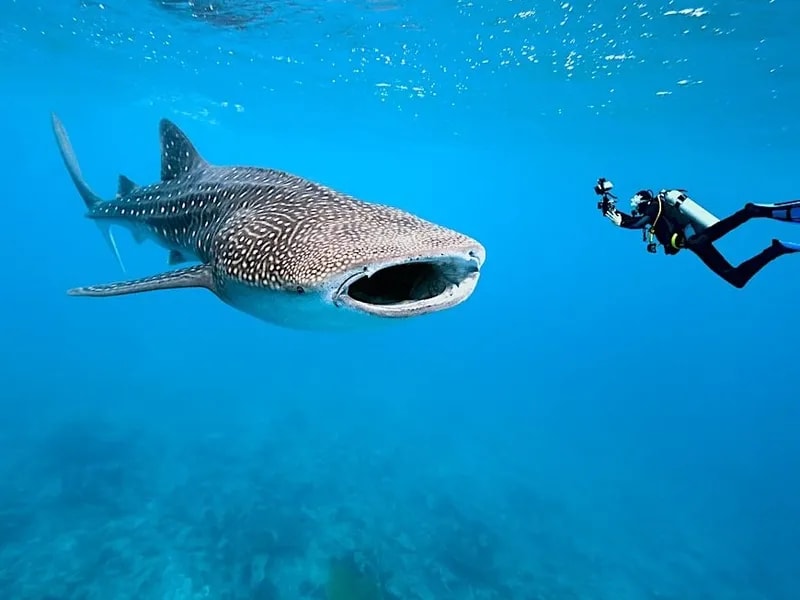
Beneath the Waters of Koh Chang — Marine Life You May Encounter
The seas around Koh Rang, the dive sites at Hin Raab, Hin Luk Bat, and the wreck of HTMS Chang represent one of the most diverse marine ecosystems in the Gulf of Thailand. Every species on this page has been documented in Koh Chang waters from diver and researcher reports — not merely "found somewhere in Thailand"
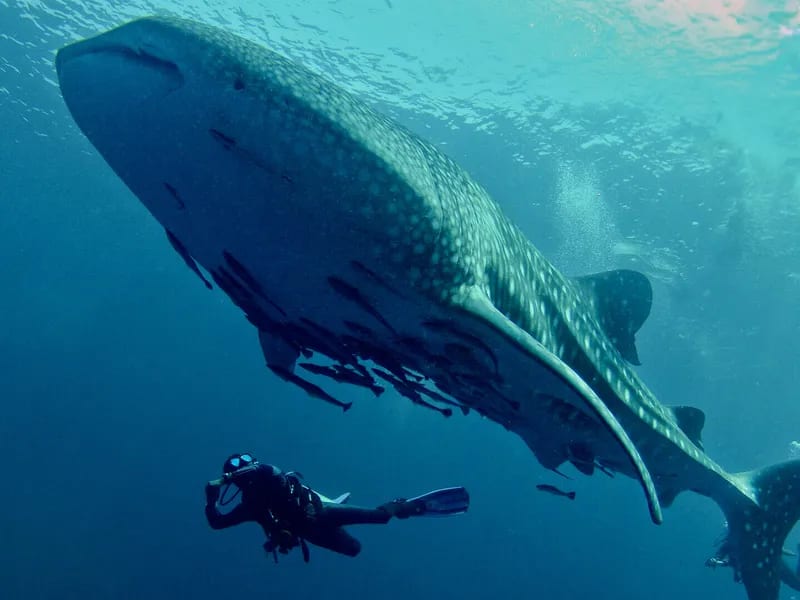
🔵 Whale Shark
Scientific Name: Rhincodon typus
IUCN Status: Endangered since 2016
Locations: HTMS Chang, Hin Raab South, Hin Luk Bat
Season: December–May (Best: January–April)
"The Largest Fish in the World" — Whale sharks are neither whales nor predatory sharks, but fish (cartilaginous) that have evolved over 60 million years. They can reach 12–18 meters in length and weigh over 20 tons — equivalent to two buses parked end-to-end. Yet they feed only on plankton, fish eggs, and tiny organisms filtered through their gills.
Why They Come to Koh Chang:
During the Dec–May season, Gulf of Thailand currents carry plankton into the waters around Koh Rang. Whale sharks follow this scent of food. Sightings near the HTMS Chang wreck have been reported multiple times per season, including photographic evidence from January 8, 2025 and January 23, 2026 directly at the wreck site.
Fascinating Scientific Facts:
- The pattern of white spots on each whale shark's body is completely unique — like human fingerprints. Scientists use photo-analysis software to identify and track individuals. The photos you take on your dive trip may have real scientific value if reported through Citizen Science projects.
- Their mouth opens up to 1.5 meters wide, filtering 6,000 liters of seawater per hour, yet their throat is only the size of a human fist. It's physically impossible for them to swallow a person.
- They can dive to 1,800 meters depth but prefer swimming near the surface at 0–40 meters, making them accessible to both divers and boat-based observers.
Responsible Whale Shark Encounter Guidelines: Maintain 3 meters distance from the body, 4 meters from the tail. Never touch with hands or equipment. No camera flash. Turn off boat engines when nearby. Let the whale shark swim past naturally.
🟢 Sea Turtle
Species Found at Koh Chang:
- Green Turtle (Chelonia mydas) — IUCN: Endangered
- Hawksbill Turtle (Eretmochelys imbricata) — IUCN: Critically Endangered
Locations: HTMS Chang, Hin Raab South, Blueberry Hill, Hin Sam Sao
Encounter Likelihood: Excellent — Sea turtles are the most frequently encountered large marine animals around Koh Chang.
Creatures that have lived on this planet for over 110 million years, once coexisting with dinosaurs and surviving mass extinction events. Yet they now face greater threats than ever in their history from just a few hundred years of human activity.
How to Distinguish the Two Species:
| Green Turtle | Hawksbill Turtle | |
|---|---|---|
| Beak | Short, rounded like a parrot | Sharp, hooked like a hawk's beak |
| Shell | Smooth with rounded edges | Overlapping serrated edges |
| Color | Brownish-green | Brown-gold-orange with beautiful patterns |
| Diet | Primarily seagrass (100% herbivore) | Sponges, coral, and jellyfish |
Amazing Facts Most People Don't Know:
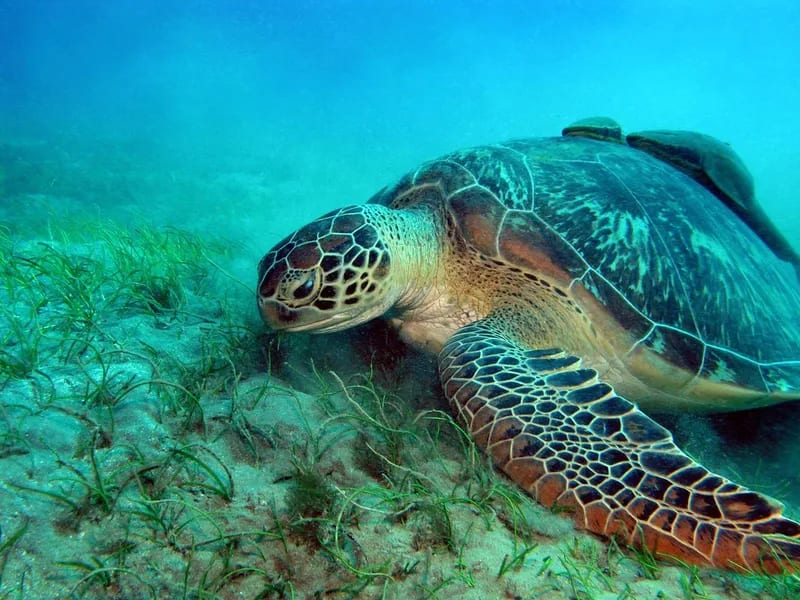
- Green Turtle — The name "Green Turtle" doesn't come from their shell color, but from the green fat inside their bodies from a lifetime diet of seagrass. They're the only sea turtle species that eats primarily plants as adults. Their consistent grazing maintains healthy seagrass beds, prevents decay, and creates habitat for thousands of juvenile fish species.
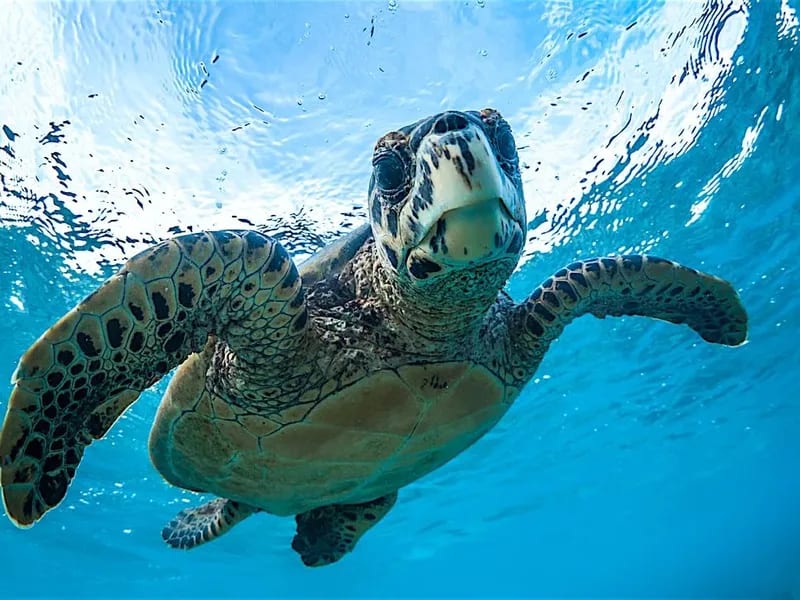
Hawksbill Turtle — The first reptile ever documented with Biofluorescence capability — their bodies can absorb blue light and emit green-red light. Discovered in 2015, scientists believe this may be used to communicate with others, though no definitive explanation exists yet.
Turtle Memory: Hatchlings memorize the unique scent of their birth beach for life. When female turtles mature, they return to lay eggs on the same beach — potentially thousands of kilometers away and decades later — navigating by Earth's magnetic field.
Sea turtle lifespan remains a mystery, but estimates suggest 80–100+ years, meaning some turtles you encounter today may have hatched before Koh Chang had electricity.
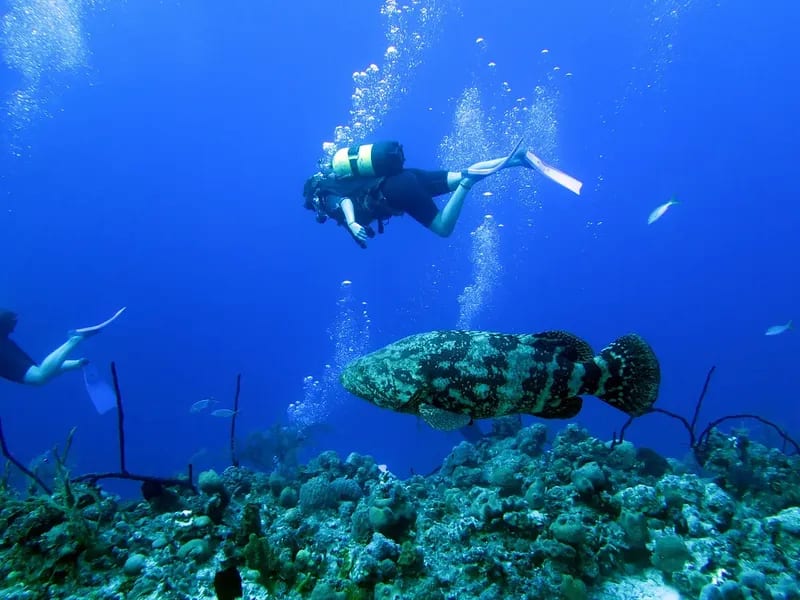
🟤 Giant Grouper
Scientific Name: Epinephelus lanceolatus
IUCN Status: Vulnerable since 2004
Locations: HTMS Chang (resident), Hin Raab South
The Largest Bony Fish in the World — reaching up to 2.7 meters in length and weighing over 400 kilograms — heavier than a water buffalo. When a body that massive hovers nearby underwater, it's an unforgettable experience.
The large giant grouper residing in the HTMS Chang wreck is a well-known "local resident" among divers. The wreck, intentionally sunk as an artificial reef in 2012, provides the ideal environment for fish that prefer hiding in large structures.
Fascinating Scientific Facts:
- All giant groupers are born female. When they grow large enough, the biggest individual in the group will change sex to become male — a process called Protogynous Hermaphroditism. This evolutionary strategy ensures only the largest, strongest males reproduce.
- They eat almost anything smaller: fish, squid, crabs, shrimp, and reports indicate they've consumed small sharks and even juvenile sea turtles.
- They hunt prey by creating suction — rapidly expanding their mouth and gills simultaneously, sucking prey in within a split second without chasing.
- Juveniles have alternating black and yellow stripes before gradually changing to uniform gray as they mature.
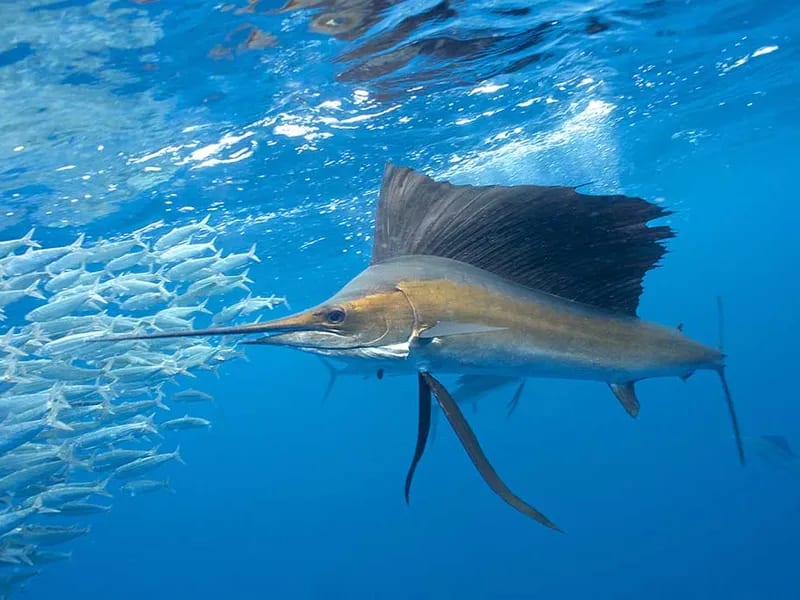
⚡ Sailfish
Scientific Name: Istiophorus platypterus
IUCN Status: Least Concern
Locations: Offshore deep water — primarily spotted from boats, not while diving
Season: October–January (Northeast monsoon)
The Fastest Swimming Fish in the World — measured at speeds up to 110 kilometers per hour, faster than cars on highways. Their massive dorsal fin that unfolds like a ship's sail (hence the name) isn't used for swimming but to herd schools of fish — circling prey and taking turns striking.
During the northeast monsoon season (Oct–Jan), cold currents push small fish schools into Trat waters. Sailfish follow their prey. Sightings from local fishermen and tour boats are reported regularly every year.
Fascinating Scientific Facts:
- Their body color can change within split seconds from silver-gray to brilliant blue when excited or hunting. Special color cells (Chromatophores) expand and contract rapidly to create this effect.
- Their long, sharp bill may be used to slash prey to stun them before eating, not just for cutting through water.
- Adult fish reach 2.5–3.4 meters in length and weigh up to 100 kilograms, yet their lifespan is only 4–5 years — creatures that "burn through life" at high speed.
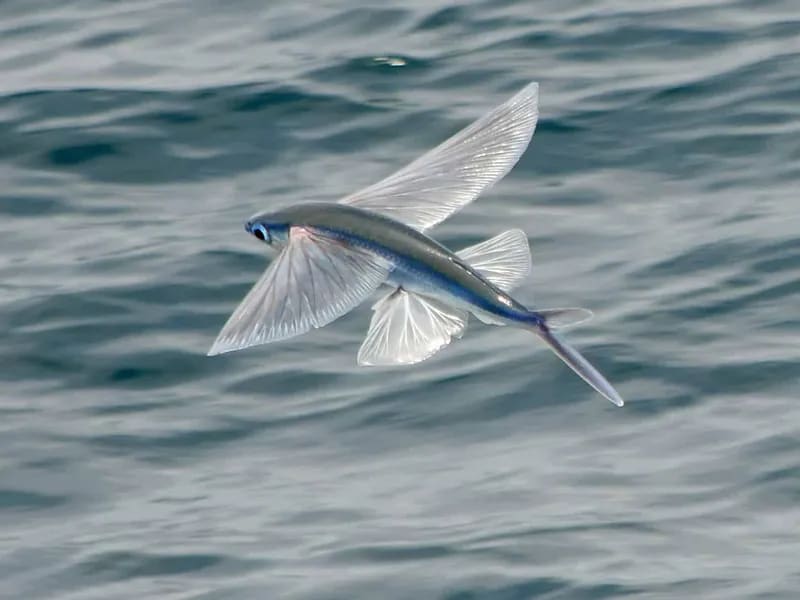
🌊 Flying Fish
Scientific Name: Family Exocoetidae (multiple species)
Locations: Surface waters offshore — visible from boats
Season: Year-round, mornings and evenings
One of the most spectacular sights from a boat deck in the Gulf of Thailand: fist-sized fish bursting from the water's surface, spreading their long wing-like pectoral fins, then gliding through the air for up to 400 meters before diving back into the water — all in just 30–40 seconds.
Flying fish don't truly "fly" but glide using thrust from rapidly beating their tails in the water. Their long, flat pectoral fins create lift like airplane wings. Some species have long front and rear fins (called Four-winged Flying Fish) that extend their gliding range even further.
Why They Glide: To escape underwater predators like tuna, marlin, and dolphins. But seabirds wait in the air — flying fish life is an escape between two worlds.
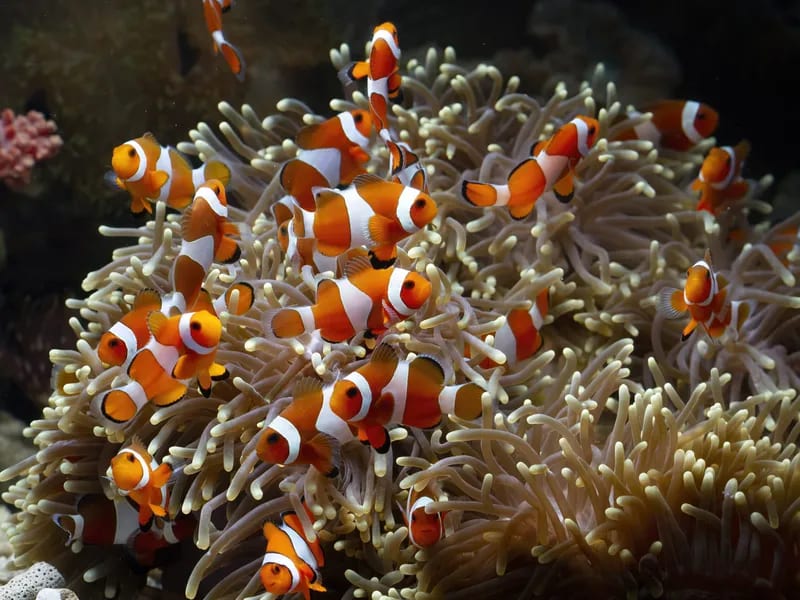
🟠 Clownfish / Anemonefish
Scientific Name: Genus Amphiprion (multiple species in Thailand)
IUCN Status: Most are Least Concern, some Near Threatened
Locations: All dive sites around Koh Rang, common while snorkeling
Encounter Likelihood: Guaranteed — the easiest fish to find on any trip
The world's most famous fish after "Finding Nemo" visits Koh Chang's waters, and their real life story is far more complex than the movie portrayed.
Relationship with Sea Anemones:
Sea anemones have venomous tentacles that can paralyze and consume regular fish. But clownfish have special protective mucus coating their bodies that prevents the venom from activating. The two species live together in mutual symbiosis — clownfish chase away fish that eat anemones, and fish waste fertilizes the anemone, while the anemone provides shelter for the fish.
Amazing Facts the Movie Didn't Tell:
- All clownfish are born male. The largest individual in the group is the dominant female. When the female dies, the most senior male will immediately change sex to become female. This means in Finding Nemo: when Nemo's mother died, his father (Marlin) should have changed sex to become the new mother — not gone searching for his son!
- Clownfish defend their territory strictly, rarely venturing more than 1–2 meters from their anemone throughout their entire lives.
- Clownfish vocalizations are produced by grinding their teeth, used for communication within the group and threatening rivals.
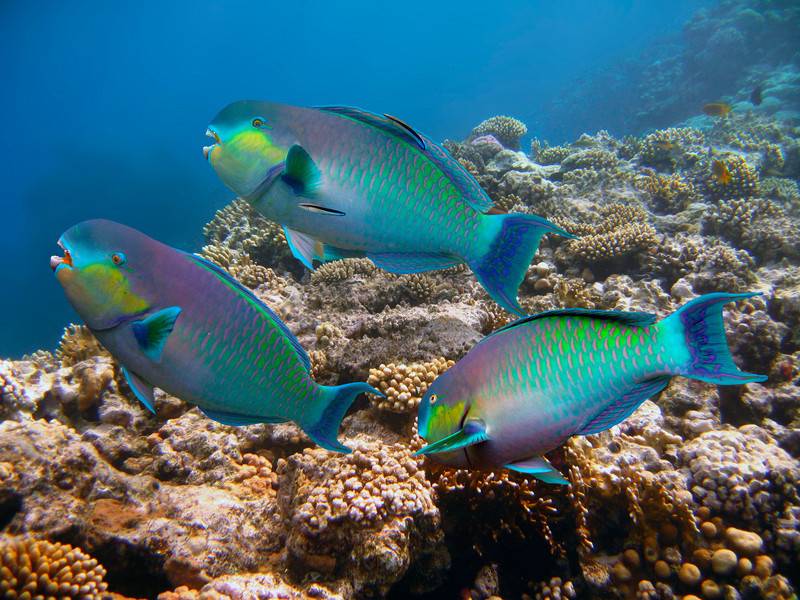
🦜 Parrotfish
Scientific Name: Family Scaridae
IUCN Status: Most are Least Concern
Locations: All coral reefs, every snorkel spot around Koh Rang
Encounter Likelihood: Guaranteed
The most vibrantly colored fish on coral reefs — purple, blue, green, pink, sometimes all in a single individual — and also the "architects" of the sandy beaches you sunbathe on.
Where Sand Comes From:
Parrotfish eat coral — but not the coral tissue itself. They bite coral to access the tiny algae living inside. This process grinds up limestone (CaCO₃) in their digestive system until fine, then excretes it as fine white sand — a single parrotfish produces 250–450 kilograms of sand per year. The beautiful sandy beaches you walk on are, in truth, partially "excrement" from these fish.
Other Amazing Facts:
- Many parrotfish sleep wrapped in a mucus cocoon they create as a protective covering. This is believed to mask their scent from predators that hunt by smell at night.
- Parrotfish coloration changes with sex and age. Males in the Terminal Phase have the most vibrant colors, while females and young males may be brown or red, sometimes appearing like completely different species.
- Their beaks are fused teeth as hard as bird beaks, designed for biting stone — the "crunching" sounds heard underwater while diving often come from parrotfish feeding on coral.
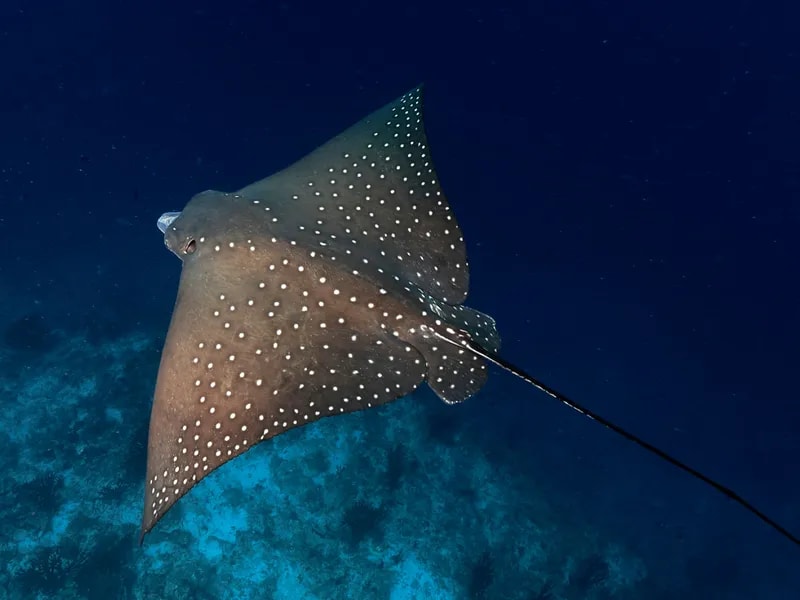
🦅 Eagle Ray
Scientific Name: Aetobatus narinari (Spotted Eagle Ray)
IUCN Status: Endangered since 2009
Locations: HTMS Chang, Hin Raab South — often swimming in pairs or small groups
Encounter Likelihood: Moderate — not guaranteed but regularly spotted throughout the season
The creature that "soars" underwater most beautifully — eagle rays swim by flapping their massive wing-like pectoral fins like birds in flight, creating a rhythmic, graceful movement through the water. Encountering eagle rays often makes divers stop swimming and simply watch, forgetting to breathe.
Physical Characteristics: White spots on a black body like a full moon night sky, duck-like snout, wingspan up to 3 meters, long tail with 2–6 venomous barbs near the base (used defensively, not for attack).
Fascinating Scientific Facts:
- They feed on shellfish and creatures buried in sand, using their snouts to dig through sand efficiently. Sometimes eagle rays are found swimming low near sandy bottoms, "excavating" for food periodically.
- They give birth to live young. Newborns have folded wings that unfold immediately after birth — able to swim from the first second of life.
- Despite their size, eagle rays can leap several meters out of the water. Theories suggest this is to shake off parasites or possibly a courtship display.
- The A. narinari species found at Koh Chang has distinctive large white spots, making them easy to distinguish from other ray species.
🗺️ Know Your Koh Chang Dive Sites
| Dive Site | Level | Depth | Notable Species |
|---|---|---|---|
| HTMS Chang Wreck | Advanced (AOW+) | 12–32 m | Whale sharks, turtles, giant grouper, eagle rays |
| Hin Raab South | All levels | 5–18 m | Turtles, clownfish, Blacktip sharks |
| Hin Luk Bat | All levels | 5–16 m | Whale sharks (occasionally), dense coral |
| Koh Yak (Koh Rang) | Beginner | 5–12 m | Clownfish, parrotfish, coral |
| Hin Sam Sao | All levels | 8–20 m | Turtles, Barracuda schools |
Best diving season for Koh Chang: November–May • Water temperature 28–30°C year-round • Underwater visibility 10–30 meters depending on weather
🤿 Universal Marine Conservation Diving Rules
— Never touch any marine life or coral — Even a light brush from your fins can destroy tissue that took decades to grow.
— No fish feeding — Though it seems harmless, it alters natural behavior and creates dangerous dependency.
— Take everything you brought — And if you see trash underwater, pick it up.
— Maintain good Buoyancy — Keep your body away from the sandy bottom. Stirred-up sediment easily damages coral health.
— Photograph freely — Take only memories and photos home.
More Stories
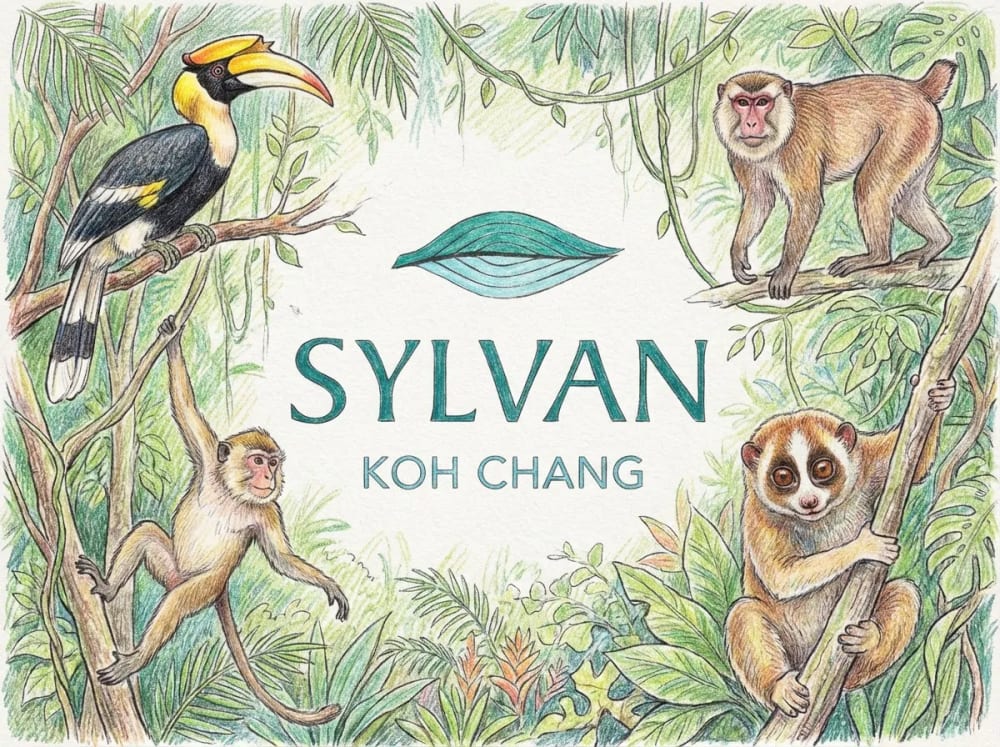
Meet the Locals of SYLVAN Koh Chang: A Wildlife Guide for Guests
Koh Chang is renowned not only for its azure seas and pristine beaches, but also as one of Thailand's richest tropical rainforest ecosystems. Nestled within Mu Ko Chang National Park, SYLVAN Koh Chang offers every guest a rare opportunity to encounter wildlife in its true natural habitat. They were here long before any of us — we are simply guests in their home.
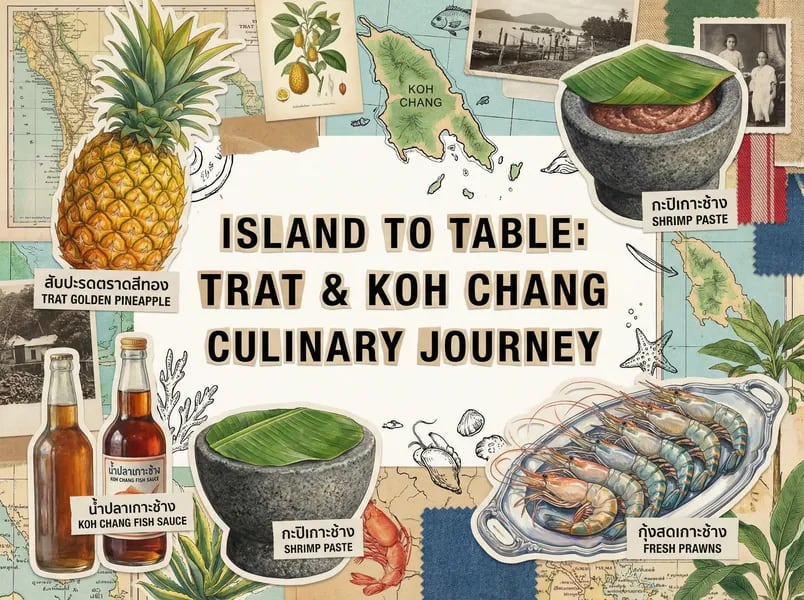
Island to Table: Where Koh Chang Comes Alive on Your Plate at Sylvie Cafe
At Sylvie Cafe, Koh Chang, we hold one simple belief — everything placed on your table should tell the story of this island. From the waves that lap the shore to the pineapple fields on the hillside, that is the essence of our "Island to Table" philosophy.

Khanom Krok: The World's #1 Thai Dessert, Made with Koh Chang Coconut at Sylvan Koh Chang
Khanom Krok — a beloved Thai classic that locals have grown up eating for as long as they can remember — has just been ranked by TasteAtlas as the #1 Thai Dessert in the World for 2025/26, placing 24th in the Top 100 Best Desserts in the World based on over 97,000 votes from users worldwide. But the Khanom Krok you'll find at The Clifftop, Sylvan Koh Chang is no ordinary coconut pancake.