

Koh Chang Waterfalls: 8 Falls, How to Get There from Kai Bae, the Best Season and Entry Fees
From Klong Plu, the one everybody visits, to Than Mayom with King Rama V's inscription and the little Kai Bae waterfall behind the resort: all 8 Koh Chang waterfalls with how to get there, fees, the best season and the story behind each.
Koh Chang is not only about the sea. More than 70% of the island is rainforest-covered mountain, and the water that runs off the central ridge becomes waterfalls on both coasts. Some are less than half an hour's walk from the car park, some need a guide and a full day, and one has a king's inscription more than a century old hidden beside its pool. This guide gathers every waterfall you can actually reach in one place, with the story behind each, who it suits, which to visit first from Kai Bae Beach, and when the water is at its best.
If you prefer a proper hike to a quick waterfall stop, read on in Unseen Koh Chang: 5 hiking trails and hidden waterfalls, which covers the long routes such as Salak Phet Peak and the Royal Footsteps trail.
At a glance: where the waterfalls are
| Waterfall | Side of the island | Entry | Walk from the car | Best for |
|---|---|---|---|---|
| Klong Plu | West (about 3 km inland from Khlong Prao Beach) | National park fee | 600 m, about 15 min | Families, first-timers, swimming |
| Than Mayom | East (past Dan Mai) | National park fee, same ticket as Klong Plu on the same day | About 200–500 m | History, quieter than Klong Plu |
| Klong Nonsi | East (behind Dan Mai) | Free (a small toll may be asked) | 10–15 min through orchards | A stop on an east-coast drive |
| Khiri Phet | South-east (Ban Salak Phet) | Free | About 10 min, flat | People who want quiet |
| Klong Neung | South-east (Salak Phet) | Free | 30 min or more, wading and scrambling | Experienced hikers only |
| Klong Koi 5-Tier | South (Salak Phet Bay) | — | A full day's hike, guide needed | Adventurers |
| Prau Talay | South (near Grand Laguna) | — | Short | Privacy, close to the sea |
| Kai Bae | West (the valley behind Kai Bae Beach) | A toll may be asked | 10–30 min depending on where you park | Guests staying on Kai Bae Beach, the closest |
| Klong Chao Leuam | North (Klong Son valley) | 40 THB parking | Cross the stream, then walk on | Many tiers without hiring a guide |
1. Klong Plu Waterfall: the island's biggest, and the one everybody visits

Photo: cloud.shepherd (Brian Miner) · CC BY 2.0

The best-known and most-visited waterfall, in the middle of the west coast. The turn-off is about 3 kilometres inland from Khlong Prao Beach, on a paved road to the car park, then a forest path along the stream for about 600 metres, 10–20 minutes, flat enough for children. The water drops more than 20 metres off a cliff into a large, fairly deep pool with fish in it, and rangers watch over the swimming area.
The story of the name: some locals say the falls were once called "Klong Phu", after Phu Pha Mek Sawan, the peak in the same area, before the name drifted to today's "Klong Plu". (A local story, not confirmed by any document.)
Its great strength is water almost all year round. Even in the dry season the lower pool is swimmable; only in some years does the water run low and the pool turn cloudy in March–April. This is the waterfall to choose on a first visit, with children, or with half a day to spare. The one drawback is the crowd from late morning to afternoon in high season. Arrive when the gate opens and the pool is nearly yours. Good to know: the canopy walk that used to be here is closed, and in the monsoon the park has issued flash-flood warnings specifically for Klong Plu. Stay out of the water after heavy rain.
2. Than Mayom Waterfall: where King Rama V carved his initials

Photo: UT (Panoramio) · CC BY-SA 3.0

On the east coast, about 15 kilometres from the piers and a few kilometres past Dan Mai, next to the Mu Ko Chang National Park headquarters. A medium-sized waterfall in four tiers, running over slabs of dark granite beneath steep cliffs in dense forest. From the car park a few hundred metres along the stream brings you to the first tier, with its pool right in front of you. The second tier is a little further up; tiers 3 and 4 are a long walk and need a ranger to guide you.
This is the most historic waterfall on the island. King Chulalongkorn, Rama V, visited Koh Chang many times (some documents say 9, others 12) and carved his royal monogram "จ.ป.ร." with the year of his visit on a rock slab beside the first pool, to the left of the falls. The Trat provincial culture book records a charming detail: on his second visit, in 1876, the king wrote a note in his own hand saying he had been here twice, placed it in a silver cigarette box inside a cup bearing the royal seal, and buried it under a pile of stones near the falls. Later searches never found it. King Rama VI and King Rama VII followed him here, which is why islanders speak of "the waterfall of three kings". The falls were originally called Klong Mayom, after the Mayom stream that runs through them.
A park ticket bought at Klong Plu is valid at Than Mayom on the same day (and the other way round). The first pool is good for a dip when the water is high, but follow the rangers: at times swimming is not allowed. Than Mayom is also the start of the Royal Footsteps hiking trail across the island's central ridge to Klong Plu, which must be booked with the park and opens and closes by park announcement. Ask before you go.
3. Klong Nonsi Waterfall: through the orchards to a small waterfall with no one around

Photo: Taweelarp Prasittinawa · CC BY-SA 4.0

A small waterfall on the east coast, hidden behind Dan Mai. A narrow concrete lane ends near the falls, or you can park and walk 10–15 minutes through the villagers' fruit orchards. No national park fee (the orchard owners sometimes ask a small toll), no shops, and hardly any tourists. The first tier is a wide staircase of rock with a small pool to sit in. The name comes from the nonsi tree, a yellow-flowering tree that grows along the streams on this side of the island.
Good water from May to November; in the dry season it may be no more than a stream. Better as a stop on a drive around the east coast than as a destination in itself.
4. Khiri Phet and Klong Neung: the Salak Phet side, where Thai history passed
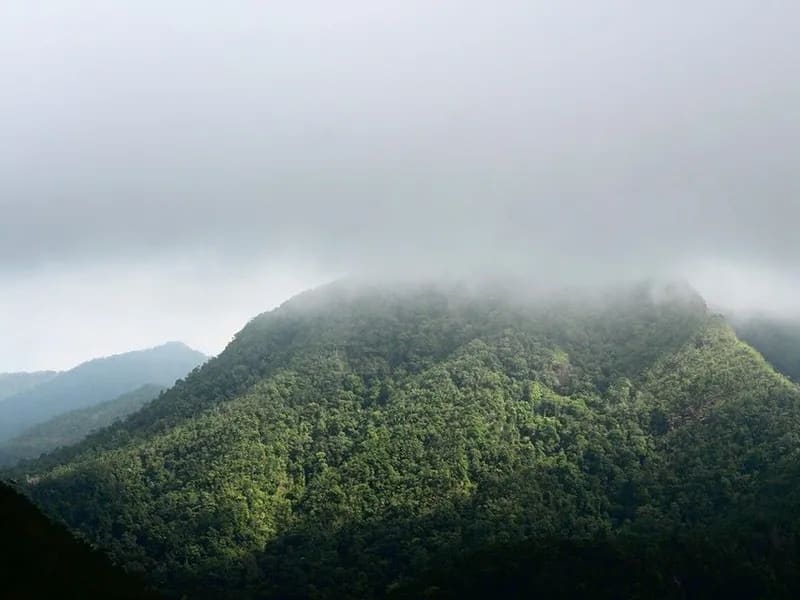
Both are in Ban Salak Phet, at the far south-eastern end of the island, and both are free.
Khiri Phet. A paved road ends at a small car park, then a flat walk of about 10 minutes to a pool you can bathe in. From the car park two unmarked paths fork; take the left one. A waterfall for people who want peace rather than spectacle. Best from the rainy season to November.
Klong Neung is the island's highest waterfall, but there is no made path. Expect at least 30 minutes of wading and scrambling over rocks, and it is dangerous when the water is strong. For experienced hikers only, and only with a local.
Something to know before you come to this side: the bay in front of you, Salak Phet Bay, was the site of the Battle of Koh Chang on 17 January 1941, when the Thai fleet met the French during the Franco-Thai war. Thailand lost the ships HTMS Thonburi, HTMS Songkhla and HTMS Chonburi. The Royal Thai Navy holds a memorial ceremony every 17 January at the Koh Chang Naval Battle Memorial in Laem Ngop, on the mainland opposite the island. If the waterfalls of Salak Phet leave you wanting more of the history, stop there on your way back to the mainland.
5. Klong Koi 5-Tier Waterfall: the reward for reaching Salak Phet Peak

A waterfall hidden in thick forest near Salak Phet Bay, with five tiers, some of them with emerald pools to soak away the climb. The way in is the same trail as Salak Phet Peak, the island's highest point at 744 metres, through bamboo forest and across small streams that cut the path from time to time. It takes a full day (6–7 hours) and you should go with a local guide. The route and how to prepare are in our hiking article.
6. Prau Talay Waterfall: the waterfall closest to the sea
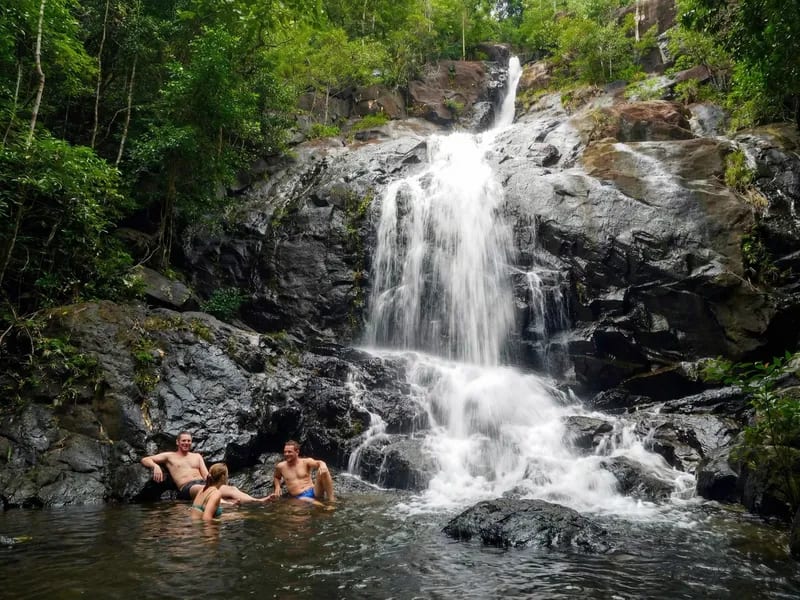
A small waterfall in the south of the island, with the way in near Grand Laguna Resort. It is one of the waterfalls closest to the sea, so you get sea breeze and forest shade in one place. Big trees and moss-covered boulders surround it, and the pool is small but clear enough to see the stones on the bottom. Most visitors skip it on their way to Klong Plu and Than Mayom, so it is quiet enough to read a book or soak undisturbed.
7. Kai Bae Waterfall: the one closest to SYLVAN
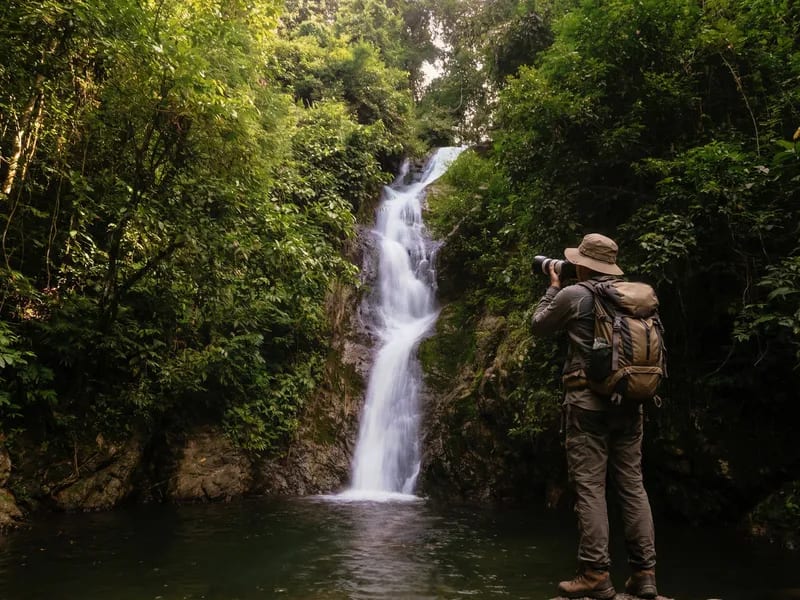
A small single-drop waterfall in the valley behind Kai Bae Beach. The way in starts at the southern end of the village: at the 7-Eleven, turn onto the dirt track and follow it for about 15 minutes on foot (a few minutes by motorbike) to the bungalows at the end of the lane, then follow the stream for another 10–15 minutes. The landowner may ask a toll. At the end is a wide, deep pool you can genuinely swim in, not just dip your feet.
The secret here is the path that continues up and around the falls. Climb the boulders and tree roots to stand about 10 metres above the drop, where the water slides slowly over a smooth rock shelf before it falls. It is a beautiful photo spot with hardly anyone there. After fresh rain the water is strong and the spray is cool, but the rock is slippery, so take extra care.
For our guests, this is the waterfall for a morning before the beach, or an afternoon when you don't feel like driving far. It is about a 10-minute drive from the resort to the start of the track.
8. Klong Chao Leuam Waterfall: a dozen tiers in the Klong Son valley
A waterfall in the north of the island, in the valley behind Klong Son village. Drive about 4 kilometres in from the ring road to where the road ends at a stream crossing and a bungalow car park (the owner charges 40 THB to park). The water comes down in more than ten tiers. The second has a small weir that holds a pool for swimming, and the fourth has the biggest pool. No national park fee. The rocks are very slippery in the rainy season. A good choice if you want a many-tiered waterfall without hiring a guide.
When the water is at its best
- May–October (rainy season, heaviest June–September). The most water and the most power; every waterfall is running, but paths are slippery, there may be leeches, and flash floods are a risk. Check the rain before you set out.
- October–December. The sweet spot: the rain eases, the weather is good, the water is still high from the end of the rains, and the walking is easy.
- January–April (dry season). The small waterfalls start to dry up from February. Klong Plu still has water to swim in, except in some years when March–April run low.
Fees and opening hours

Two waterfalls charge the Mu Ko Chang National Park fee: Klong Plu and Than Mayom. The current rate (national park, June 2026) is 40 THB for Thai adults and 20 THB for Thai children; for foreign visitors 200 THB for adults and 100 THB for children aged 3–14, with small children free. Pay cash at the gate. One ticket covers both waterfalls on the same day. The fee booths open about 08:00–16:30 at Klong Plu and 09:00–16:30 at Than Mayom (some sources say until 17:00). The other waterfalls charge no park fee and have no opening hours, but be out of the forest before dark.
From Kai Bae Beach: which waterfall first
- Half a day: Kai Bae in the morning, then on to Klong Plu just up the coast to the north, and back in time for lunch.
- A full day with a car: drive north through Klong Son (Klong Chao Leuam is a possible stop), round to the east coast for Klong Nonsi and Than Mayom, down to Salak Phet for Khiri Phet, then back the same way. The ring road does not close the loop, so you must return the way you came, and the east coast has few petrol stations: fill up before you leave.
- A serious hike: hire a guide for Klong Koi and Salak Phet Peak, or ask the park about the Royal Footsteps trail.
- No car? Ask our front desk about transfers and guides, any day.
Take care
- The rocks beside the waterfalls are very slippery, especially after rain. Wear shoes with grip; ordinary flip-flops are not suitable.
- Do not go into the water straight after heavy rain. Levels rise fast, especially at Klong Plu.
- No jumping from the cliffs into the pools. Their depth changes with the season.
- Carry drinking water and insect repellent; in the rainy season there are leeches on some stretches of path.
- Take every piece of rubbish back out, and do not feed the wildlife.
Frequently asked questions
Which is the most beautiful waterfall on Koh Chang? For size and the pool, Klong Plu. For the story and the quiet, Than Mayom. For many tiers without a guide, Klong Chao Leuam. For adventure, Klong Koi 5-Tier.
Can you swim? Yes at Klong Plu, Kai Bae, Klong Chao Leuam, Prau Talay and Klong Koi. At Than Mayom you can swim in the first pool when the rangers allow it. Klong Nonsi and Khiri Phet have small pools, better for a soak than a swim.
Can I go on my own, or do I need a guide? Klong Plu, Than Mayom tiers 1–2, Klong Nonsi, Khiri Phet, Prau Talay, Kai Bae and Klong Chao Leuam are all fine on your own, on clear paths. Than Mayom tiers 3–4 need a ranger. Klong Neung, Klong Koi and Salak Phet Peak should be done with a local guide.
Is there water in the dry season? Klong Plu has water almost all year. The other small waterfalls start to dry up from February. If you come in March–April, make Klong Plu your one waterfall and you won't be disappointed.
Which waterfall is closest to Kai Bae Beach? Kai Bae Waterfall, in the valley behind the beach. Next is Klong Plu, to the north.
When the waterfalls are done, come back and rinse off in the sea in front of your room. See the rooms and villas of SYLVAN Koh Chang on Kai Bae Beach
More Stories

Meet the Locals of SYLVAN Koh Chang: A Wildlife Guide for Guests
Koh Chang is renowned not only for its azure seas and pristine beaches, but also as one of Thailand's richest tropical rainforest ecosystems. Nestled within Mu Ko Chang National Park, SYLVAN Koh Chang offers every guest a rare opportunity to encounter wildlife in its true natural habitat. They were here long before any of us — we are simply guests in their home.

Which room at SYLVAN Koh Chang? A guide to all 9 room types and who each one suits
Beach or clifftop, couple or family, a private pool or the fullest sea view: this guide walks through all 9 room types at SYLVAN step by step until you know which to book.
When Is the Best Time to Visit Koh Chang? A Month-by-Month Guide
Beach weather, calm seas, waterfalls or the lowest rates — every month on Koh Chang is good for something. Here is what to expect from the weather, the sea and the prices in each season, so you can pick the month that fits your trip.